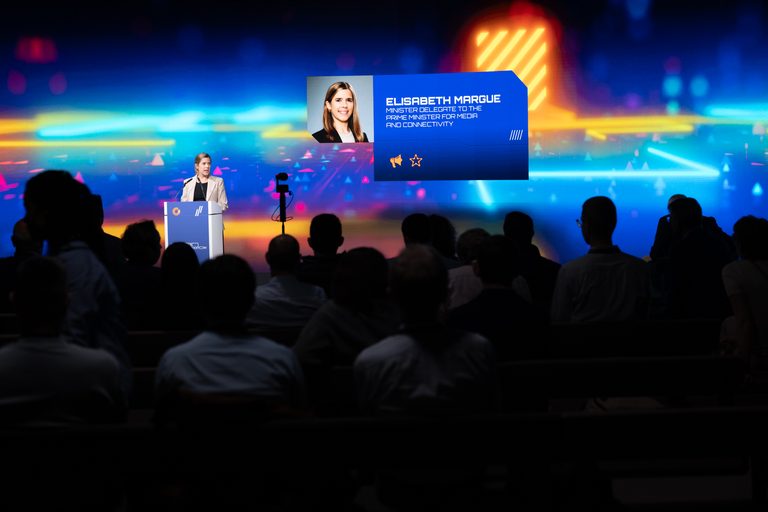
Connectivity in sport is a multi-faceted topic, offering material for several fascinating chapters in your summer reading. In June, MyConnectivity organised the “Connecting Tomorrow” side event as part of Nexus Luxembourg 2026. Throughout the day, experts from sport, esport, technology and event management explored the invisible infrastructure that underpins performance, safety and the fan experience. This summer, we are revisiting the key takeaways from these discussions. This week: lag and the infrastructure esport needs.
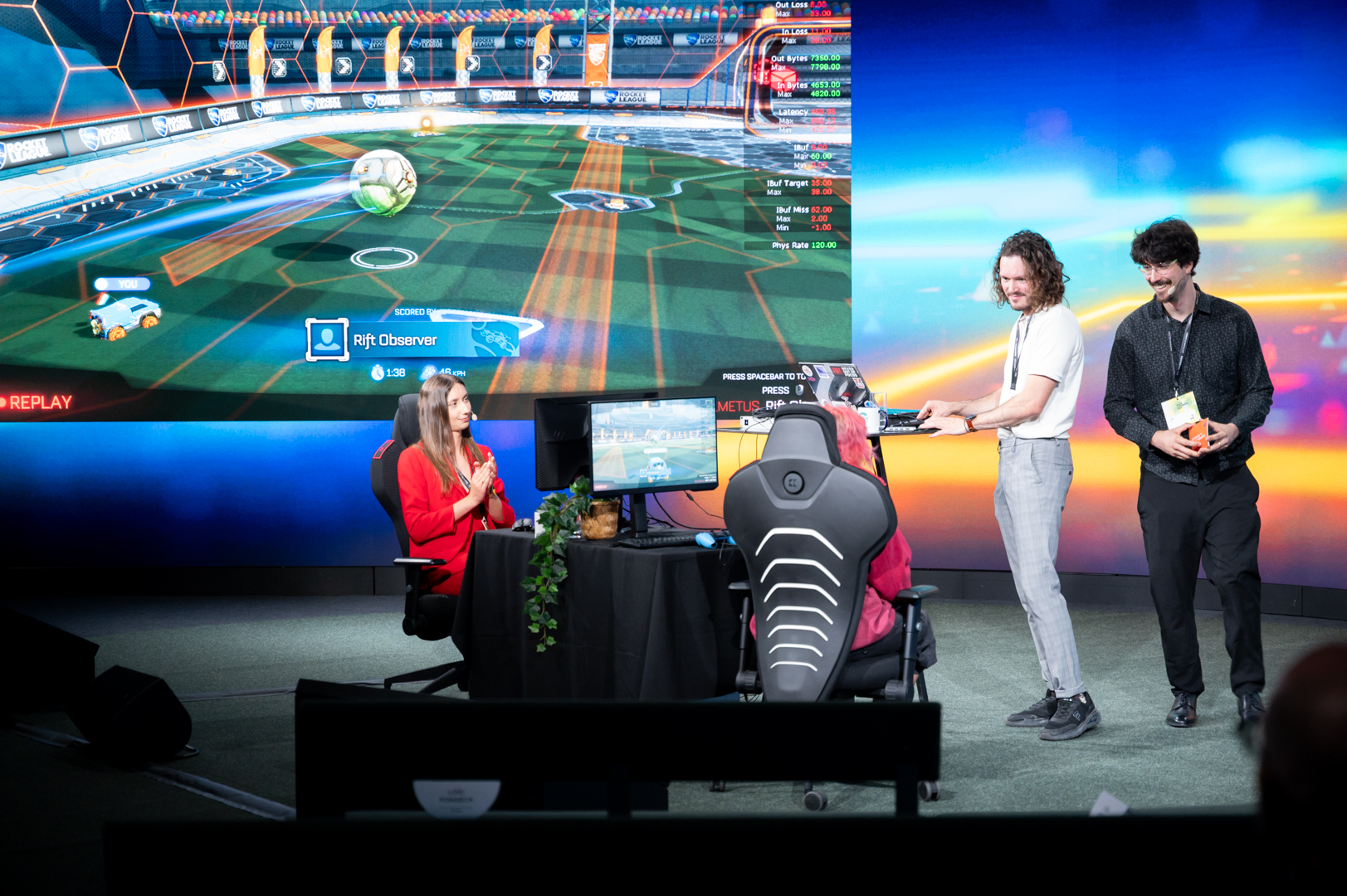
Can a fraction of a second turn a perfect play into a baffling mistake? And how can fair conditions be guaranteed when players, servers and organisers all depend on a complex technical chain? These were the questions brought to life through a Rocket League demonstration led by Luka Trenz, Lena Rocca and Loïc Cordeiro Fonseca.
Making lag visible
On stage, two computers ran Rocket League side by side. One had a normal connection; the other could be deliberately slowed down and subjected to packet loss. A former professional Clash Royale player turned esport commentator, Luka Trenz guided this experiment designed to show the audience what players feel when the network can no longer keep up.
Lena Rocca, the first female Luxembourger to compete at the Counter-Strike World Championship, had to play under conditions that were at times heavily degraded. Her car moved in jerky bursts, the ball suddenly changed position, and some commands only took effect after the action had already happened.
The demonstration deliberately pushed the phenomenon to the extreme, but it reproduced a familiar situation. Lena Rocca explains that at home, an unstable connection can let an opponent see her before she even properly appears on her own screen. In a shooting game, that gap of a few milliseconds can decide a duel.
Talent remains essential, but it cannot come through when information arrives too late. A player may know the game perfectly, anticipate the action and react at exactly the right moment; if their command arrives after their opponent’s, the displayed performance no longer reflects their real level.
Ping, the invisible stopwatch
Loïc Cordeiro Fonseca, co-founder of RIFT, explained that “ping” measures the time it takes for information to travel from the computer to the server and back. This latency, expressed in milliseconds, indicates the delay with which the game registers a command.
The computer and the server are constantly exchanging information: a character’s movement, an opponent’s position, a ball’s trajectory, or a triggered command. When these messages are delayed or lost, the two sides no longer share the same picture of the game. What appears on screen may, from the server’s point of view, already belong to the past.
During the experiment, latency reached several hundred, and at times over a thousand, milliseconds. A half-second delay seems trivial in everyday life; it becomes enormous in a discipline where decisions are made almost instantly. The game can even end up freezing or crashing, as happened during the demonstration.
This asymmetry can even be created deliberately, to produce an exploitable gap between what one player sees and what their opponent perceives. Such manipulation amounts to a form of cheating. Above all, it is a reminder that competitive integrity requires comparable technical conditions for everyone.
Two networks and comparable equipment
In a tournament held at a single venue, fairness depends on work that goes unseen: wiring the stations, configuring the equipment, testing the data flows and preparing backup solutions. RIFT favours running two separate lines. The first is reserved for the stage and the broadcast; the second serves exhibitors and visitors, so that unexpected traffic doesn’t penalise the players.
The network alone is not enough. Computers should ideally be identical, especially in games pitting two teams of five against each other. Processors, graphics cards, screens and peripherals must all deliver similar performance. Otherwise, the organiser would itself be creating an inequality between competitors.
Despite every precaution, an incident can still happen. Loïc Cordeiro Fonseca then recommends isolating the source of the problem, testing components one by one, and if necessary, switching to a mobile 4G or 5G connection prepared in advance. This remains a last resort, but it must be planned for from the design stage. Redundant infrastructure protects both the live broadcast and the sporting result.
Online, fairness becomes more fragile
When a competition takes place remotely, the organiser controls neither the equipment nor the connection of each participant. Lena Rocca recalls that members of her team were unable to finish qualifying matches because of an unstable connection. Their elimination reflected neither their preparation nor their level.
Rules can allow for a pause or the postponement of a match. For Loïc Cordeiro Fonseca, the response is sometimes as much human as technical: it means acknowledging that an incident can be beyond a player’s control and looking for a fair solution. But a competition’s schedule doesn’t always allow for an indefinite wait.
Professional organisations reduce this risk by providing equipment or bringing players together in suitable training facilities. This shift confirms that esport is not simply about playing at home: it requires collective organisation, coaches, analysts and a well-managed technical environment.
Data also looks at the player’s body
Connectivity isn’t just used to transmit in-game actions. It also powers tools designed to track health and performance. Loïc Cordeiro Fonseca mentions trials of sensor-equipped clothing capable of monitoring posture and vibrating when a player sits or stands incorrectly.
The stakes are real: professionals spend long hours in front of a screen and can develop issues linked to a sedentary lifestyle or poor posture. Their preparation therefore includes physical activity, a suitable diet and close attention to recovery.
Lena Rocca also sees value in tracking heart rate and stress levels. This data could help explain why tension rises at certain moments and how to manage it better. She notes that psychological support can matter just as much as tactical analysis when it comes to decisive moments.
That said, technology should not be imposed simply because it exists. Some of the clothing tested proved uncomfortable. For Loïc Cordeiro Fonseca, tools need to be developed with players and fit their actual practices. An intrusive sensor doesn’t become useful just because it generates more data.
An access issue in Luxembourg
In Luxembourg, many venues can host an association or a local tournament, but they don’t always have a network suited to competition and simultaneous broadcasting. The venue manager, the organiser, the technical provider and the internet service provider therefore need to plan the event together.
A large-scale event brings together several partners. As the audience, the number of players and broadcasting needs grow, every link in the chain has to scale up too. Installing dedicated fibre takes time, equipment and a budget that can exceed what smaller organisations can afford.
Access also plays out at home. Cloud gaming can reduce the need for a very powerful computer, since the game runs on a remote server and only the image is streamed back. But it increases dependence on a fast, stable and responsive network. Luka Trenz points out that 5G can offer a complementary solution in certain areas. Equipment, coverage and the price of services all determine who can actually access competitive gaming.
Gaming and networks growing together
For Loïc Cordeiro Fonseca, the growth of esport and that of digital technology feed off each other. The earliest Counter-Strike competitions took place mainly over local networks: players brought their own computers and connected to a server set up on site.
As connections improved, tournaments were able to open up to more competitors and reach a global audience through live streaming. In turn, video gaming drove demand for more powerful graphics cards, faster servers and networks less prone to latency.
The Connecting Tomorrow demonstration made visible what the spectacle usually hides. Behind a fluid move lie a terminal, cables, routers, operators, a server and technicians. When one of these elements slows down, the player’s talent doesn’t disappear; it simply becomes impossible to see properly.
In esport, performance is therefore born from the meeting of a player’s skill, their team, and an infrastructure capable of transmitting every decision without distorting it. Guaranteeing that chain means protecting the game itself, the fairness of competition, and the possibility for new talent to access it.