The second edition of the “Connecting Tomorrow” side event
What role does esport play alongside traditional sporting disciplines, and what level of connectivity do these two worlds require, whether they converge or evolve independently? These were the questions at the heart of “Connecting Tomorrow”, held for the second time by MyConnectivity on 10 June as part of Nexus’ 2026 edition. The discussions covered a range of perspectives, from competition and performance to cybersecurity, event security and marketing.
A full day devoted to the hidden layers
Reflecting the range of the topics covered, the 2026 edition ran for a full day for the first time. The morning was devoted to immersive experiences and hands-on gaming, while the afternoon featured a keynote, one-on-one interviews and several panel discussions. The Pocket Networking sessions and the closing drinks reception also provided opportunities for more informal exchanges.
The day opened with a game of Rocket League, during which Luka Trenz, Lena Rocca and Loïc Cordeiro Fonseca demonstrated the impact of lag. Their demonstration was a reminder that a slow or unstable connection can affect gameplay, undermine fairness between players and limit access to competition.
This was followed by Operation Poseidon, a collaborative experience designed by Virtual Rangers. Guided by Mathieu Brachetti, participants were plunged into a cyber crisis in which success depended as much on technology as on communication and human behaviour.
Formula 1: a prime example
One of the highlights of the afternoon was the keynote by Mark Gallagher, a Formula 1 industry executive and expert. He showed how a championship historically centred on mechanics has evolved into a global technology industry, in which data, simulation, remote production and digital content contribute as much to performance as to the business model.
A modern team no longer relies solely on the drivers and mechanics present trackside. A large part of its engineering staff works from headquarters, where data transmitted by the race car is analysed in real time. Even before the race starts, millions of scenarios can be simulated to anticipate tyre wear, changing weather conditions, pit stops or the deployment of a safety car.
Max Verstappen’s performance at the 2021 French Grand Prix illustrated how technology and data can shape race strategy. While running behind Lewis Hamilton, Red Bull’s strategy tools recommended an additional pit stop that initially seemed costly. The simulations showed, however, that fresh tyres would allow Verstappen to close the gap. He eventually overtook his rival on the penultimate lap, following a strategic decision that brought together software, data and the expertise of engineers, mechanics and the driver himself.
Connectivity is also transforming the way Formula 1 produces and broadcasts its events. Footage can now be edited, enhanced with graphics and distributed from a remote production centre. By moving data rather than production facilities, equipment and staff, the championship can reduce its logistical requirements and associated environmental footprint.
This shift is also reshaping the relationship with fans. Supporters no longer just follow a race on television: they check statistics, listen to radio communications, watch content produced by the teams and sometimes even race on the same virtual circuits. Sim racing has thus become not only a training tool, but also a media platform and a new way for fans to engage with the sport and its brands.
From the simulator to sporting performance
The interplay between connectivity and performance was also central to the contributions from Wolfgang Reip, Sarah Bovy and Lenny Kieffer. Their careers show that the boundaries between sim racing and real racing are becoming increasingly blurred. Telemetry facilitates learning, while radio communication and data flows keep the driver constantly connected to their team.
Wolfgang Reip offers a striking illustration of this. After winning Nissan’s GT Academy through Gran Turismo in 2012, he made the transition from sim racing to a professional driving career and top-level GT competition. Now a machine learning engineer at Track Titan, he uses telemetry to turn driving data into advice that sim racers can understand.
At 16, Lenny Kieffer illustrates the same connection between virtual and real-world racing. The Luxembourger combined karting with intensive sim racing before winning the Volant 11 by The Grid, which opened the door to a season in GT4 France. For him, braking points, racing lines and the search for consistency link the two worlds, even though the track adds heat, G-forces, fatigue and physical risk.
Iron Dame Sarah Bovy pointed out that connectivity remains just as decisive once the driver is competing on track. At the 24 Hours of Le Mans, radio communication provides drivers with information on tyres, fuel, weather and strategy. Backup procedures exist, but an outage at the wrong moment can cost several positions.
Beyond motorsport, Raymond Conzemius, Alwin De Prins and Olga Barrera examined the role of sensors, artificial intelligence and scientific support in elite sport. All agreed that data can inform decisions, personalise training or support recovery after injury, but cannot replace either human expertise or the athlete’s own responsibility.
On the track and behind the scenes
The final discussions turned to the organisation of major events. Claude Rach explained how events such as the Tour de France or the Dakar Rally transform a new location into a temporary stadium every day. Gérard Carmona, Yann Figuet and Bertrand Rojat explored the communications infrastructure combining priority communications, 5G, fibre and satellite to support security, broadcast production and public connectivity simultaneously.
At a travelling event, connectivity goes beyond transmitting images. It also makes it possible to coordinate local authorities, teams, emergency services, partners and volunteers. In the desert, satellite links also help track competitors and trigger a response when a vehicle stops unexpectedly.
In a stadium, several networks must operate simultaneously. Security forces need priority communications; broadcasters carry video feeds and spectators share their own content. Reliability therefore depends on how these technologies work together and on backup solutions prepared before the venue opens to the public.
Finally, Stefan Heldens, Michel Vandaele, Sébastien Faye and Bruno Cavaleiro showed that stadiums can serve as laboratories for connected cities. The experiments carried out at Belval, the SmartSpires project and the new districts of Metzeschmelz and Rout Lëns in Esch-sur-Alzette ground this discussion firmly in the Luxembourg context.
Opportunities and challenges: the series continues this autumn
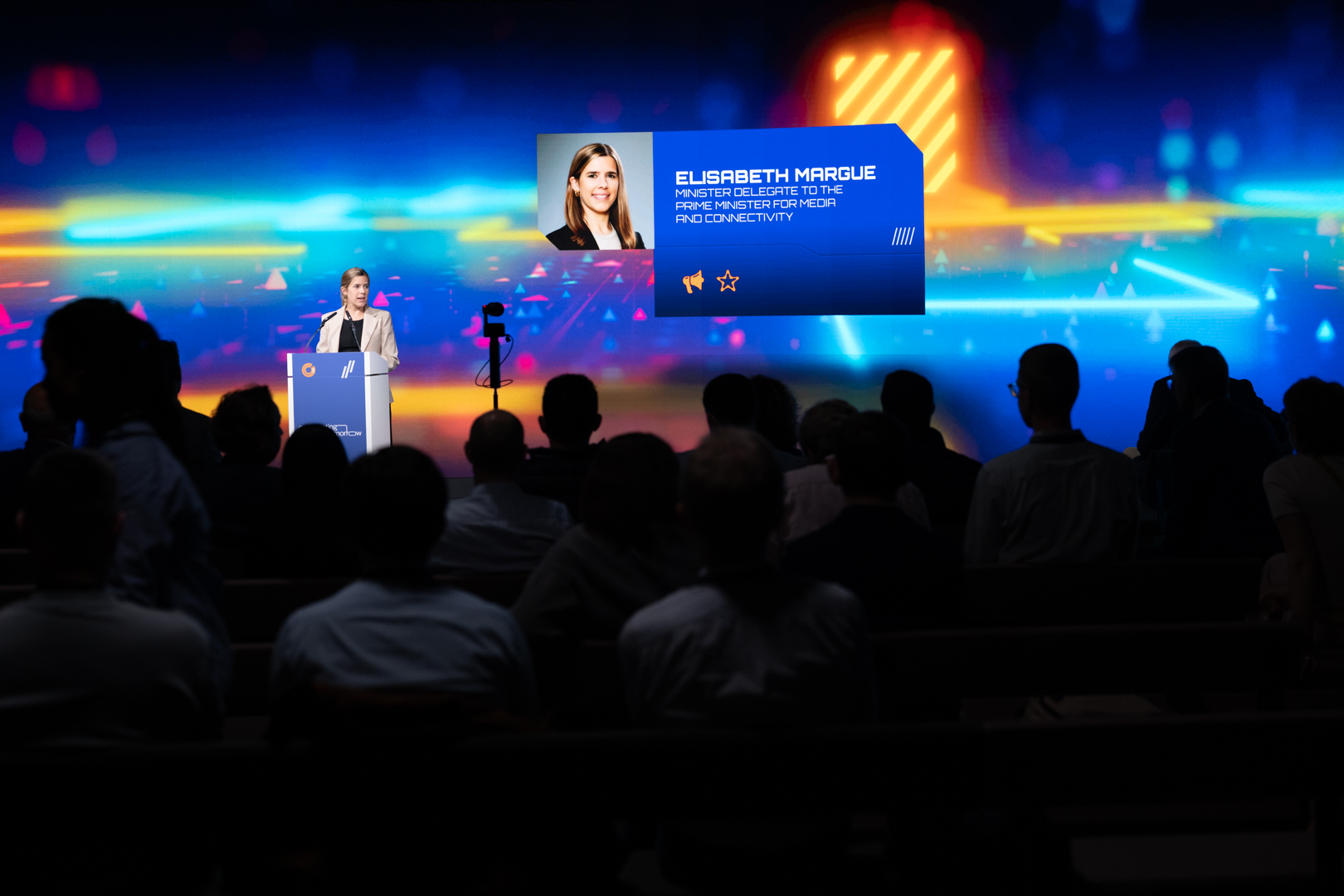
From different angles, each contribution highlighted just how essential connectivity has become to the world of sport, as well as its broader socio-economic importance. They thus echoed the messages delivered by Elisabeth Margue, Minister Delegate to the Prime Minister, responsible for Media and Connectivity, and Julien Larios, CEO of MyConnectivity. In their opening remarks, both highlighted Luxembourg’s strengths, while stressing the need for continued investment, secure networks and infrastructure that translates into useful services.
Elisabeth Margue stressed the need for reliability, security and sovereignty alongside network performance. Julien Larios, for his part, placed these issues within the “connectivity race”: high-quality infrastructure is an advantage, but one that must be continually maintained as usage evolves and data volumes grow.
Over the coming weeks, eight articles will revisit the key takeaways from the day: Operation Poseidon; lag and fairness in esport; Formula 1 with Mark Gallagher; the journey from simulator to track; the question “Can you still win without technology?”; the organisation of major, travelling’ events; the technical infrastructure behind global events; and finally, the role of stadiums in building tomorrow’s urban connectivity.
Each article will explore one of these themes while placing it in a Luxembourg context. The aim is not only to describe these technologies, but to understand how they are changing the experience of athletes, organisers, businesses, regions and the public.